The End of the “I Want to Be First on Google” Era
An analysis of why the obsession with the “first place” on Google is now a thing of the past. This article explains how AI, AI Overviews, and personalization are changing SEO, shifting the focus from keywords to true authority and user experience.
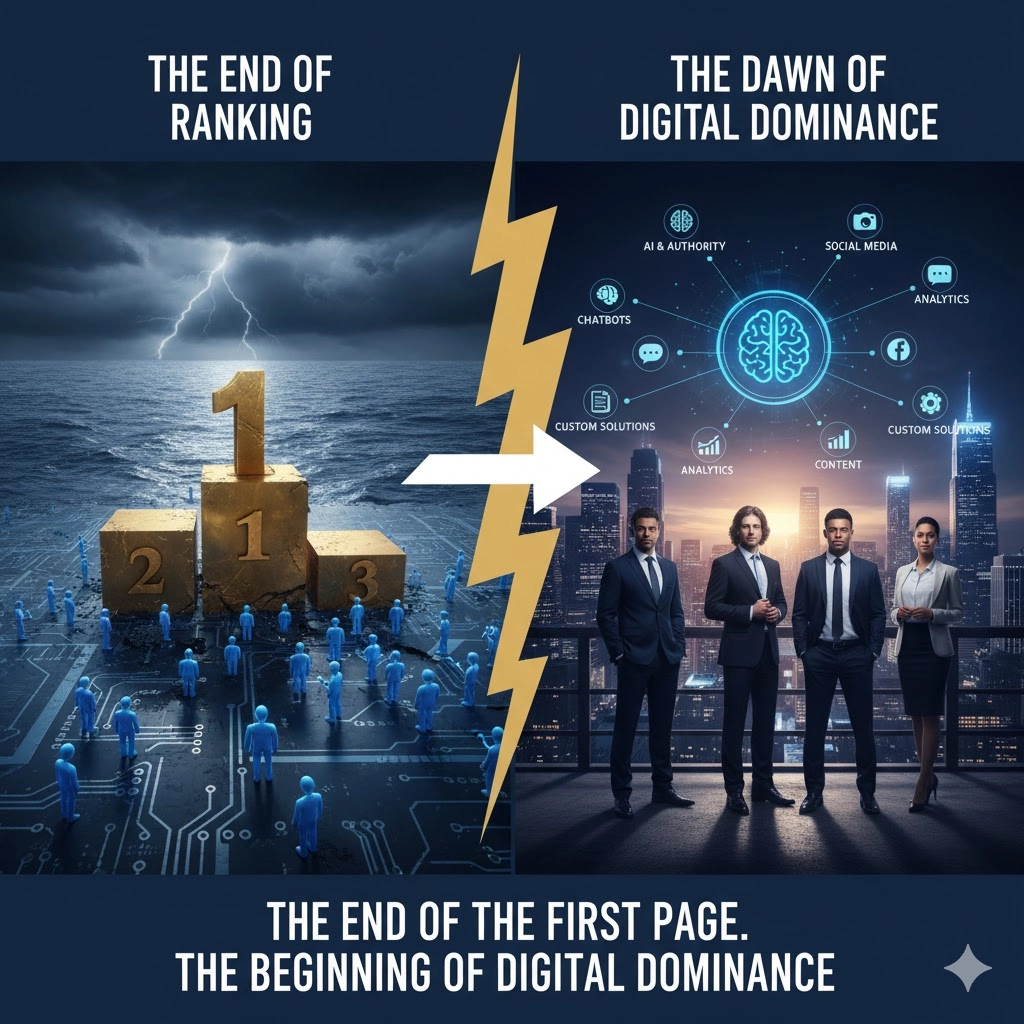
“I want to be first on Google.”
For over a decade, this phrase was the ultimate obsession for every business. It was the holy grail of digital marketing, the absolute measure of success. Conquering the top spot meant everything: prestige, traffic, customers.
Today, that obsession feels more like a romantic memory of a bygone era. Simply asking to “be first” is like asking for the best phone booth in town. Technology has moved on, and the game has fundamentally changed.
The reality is that the “first place” on Google, as we knew it, no longer exists. And that is the best possible news for businesses that invest in real value through modern tailor-made software development, instead of short-lived gimmicks.
Why is “First Place” Now a Myth?
The change didn’t happen overnight, but it was an earthquake that had been building for years. There are four main reasons why the old SEO strategy has collapsed:
1. There Is No Single “First Place” (Personalization)
What you see as the first result is not what I see. Google’s results are completely dependent on:
- Your location: (e.g., “software company” will show results near you).
- Your search history: Google learns what you prefer.
- Your device: (Mobile vs. Desktop).
There is no longer a single, universal winner. There are millions of micro-winners, tailored to billions of unique searches.
2. The Results Page Is No Longer 10 Blue Links
Do a search. What do you see before you even get to the first “organic” result?
- AI Overviews: Google now answers the question itself, synthesizing information from multiple sources.
- Featured Snippets: “Boxes” that provide the answer directly.
- People Also Ask: Accordions with related questions.
- Local Pack: A map and three businesses.
- Videos and Images: Visual content that dominates.
The goal is no longer to be the link to the answer. The goal is to be the answer.
3. The Generative AI Revolution
This is the real catalyst. Google’s AI Overviews and the rapid evolution of advanced AI and machine learning solutions are changing how we search. Users no longer search using stiff keywords (“software Athens”). Instead, they ask complex, conversational questions (“what is the best solution to connect my office’s access control to an HR portal?”).
In this new landscape, Google doesn’t just want to find a page that contains those words. It wants to find the most trusted and expert source to base its AI answer on.
4. The Rise of “Zero-Click” Searches
More and more users find the information they want (e.g., a phone number, an address, a quick fact) directly on the results page and never click on an external link. Traffic as an end goal is dying.
If Not First Place, Then What? The New Strategy
If old-school SEO is dead, what replaces it? The answer is a holistic strategy built on technology and real value.
1. From Ranking to Relevance
Stop thinking about broad, competitive keywords. The new goal is dominance of user intent.
It is infinitely more valuable to be the absolute, comprehensive answer for how to construct a unified corporate architecture using intelligent automation and API integration than to be on the 20th page for the vague word “software.” The first brings you a high-intent client who knows exactly what they need. The second only brings noise.
2. From Keywords to Authority (E-E-A-T)
Google’s modern ranking paradigm is summarized by one critical acronym: E-E-A-T (Experience, Expertise, Authoritativeness, Trustworthiness).
Google (and its AI algorithms) is constantly asking, “Can I trust this source enough to serve its data to millions of users?” Your blog, your case studies, and your deep technical breakdowns are no longer just “content.” They are digital proof of your real-world authority. This is why the quality of 10 excellent, highly insightful articles is worth far more than 100 mediocre ones.
3. From Google… to Everywhere (Omnichannel Presence)
The customer’s journey doesn’t start and end with a search engine. It might start with a social media bot, continue to an article on your corporate blog, move to an automated email follow-up, and conclude across a cohesive ecosystem of dedicated mobile and desktop apps or custom-built enterprise custom web applications and platforms.
Victory today isn’t about sitting in “first place” on a single platform. It’s about maintaining a seamless, intelligent presence at every single digital touchpoint a customer has with your brand.
4. From Traffic to Conversion
What’s the point of being in first place if your website is slow, confusing, and the visitor leaves in 3 seconds?
Investing in a high-speed, custom-designed system with a flawless User Experience (UX) and a clean User Interface (UI) is now infinitely more important than any old SEO trick. “Conversion”—getting the user to execute the desired business action—is the only true king left.
The Battle Has Shifted
The battle is no longer for “first place” on a screen. It’s for being the “first thought” in a customer’s mind when they face a complex problem you can solve.
Instead of chasing yesterday’s algorithms, at Saikō, we focus on building tomorrow’s digital experiences. Because an intelligent, fast, and reliable solution will always win, regardless of what the search landscape looks like five years from now.
Are you ready to stop chasing rankings and start building a digital strategy that wins customers? Contact us.