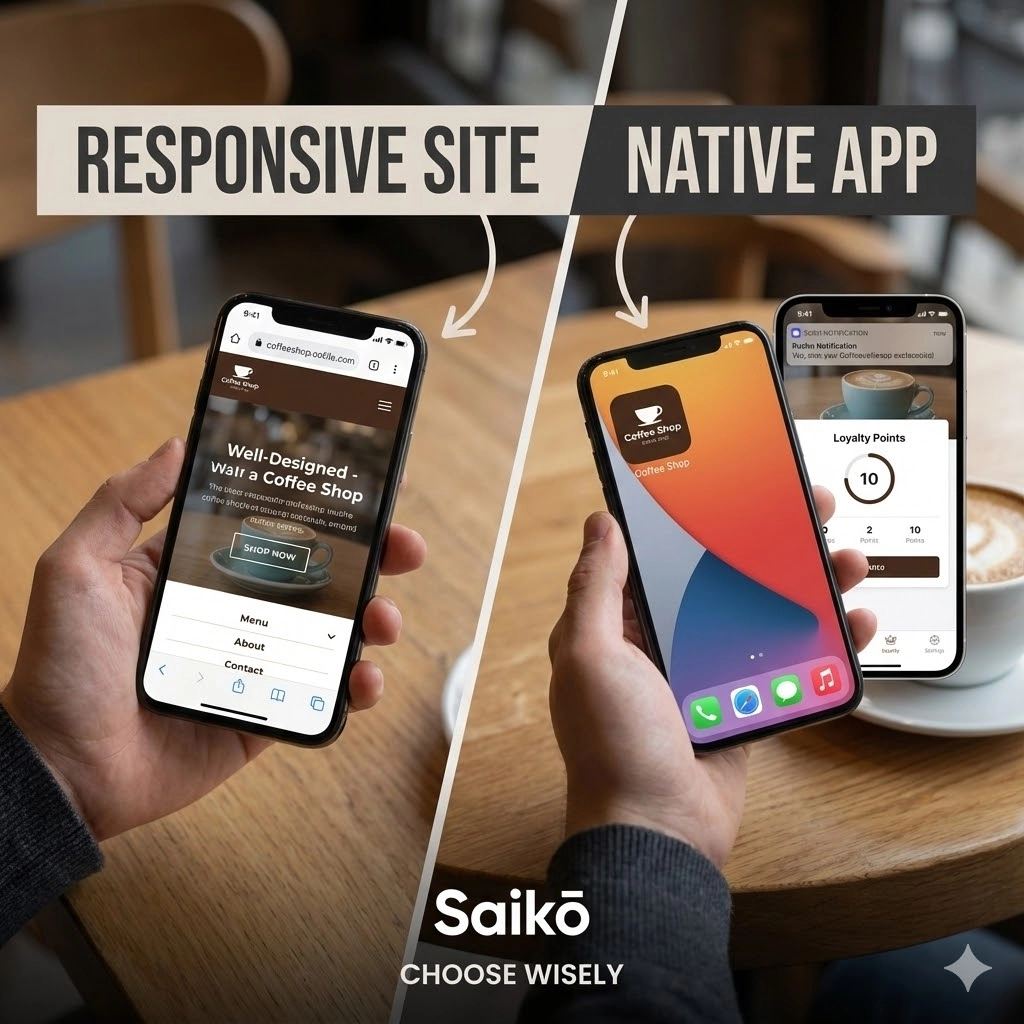
It’s one of the most frequent conversations we have with new clients at Saikō. The enthusiasm is palpable: “We want to build an App! We want customers to go to the App Store, download us, and have our icon right there on their phone screen.”
It sounds great, doesn’t it? It signals corporate prestige; it signals modernization. And then comes our key question: “Why?”
Usually, silence follows. Or a hesitant answer like: “Well, to be on their phones, of course.”
Here lies the major misunderstanding. Being accessible via mobile is absolutely essential (over 70% of web traffic now comes from handheld devices). However, rushing into building an independent Native App isn’t always the right way to achieve that goal. Often, businesses invest thousands of euros building an App that essentially does nothing more than display the exact same information already available on their website. Without a strategic assessment and a clear approach to tailor-made software development, that is simply wasted money.
Let’s clear things up so you can make the right decision for your budget.
The Foundation: What is a Responsive Mobile-Friendly Site?
It’s your website, but “smart.” It is designed to adapt automatically, “flowing” to look flawless on any screen size, from a massive desktop monitor to the smallest smartphone.
- When it’s the right solution: For 80% of businesses, a highly optimized responsive layout—even when managing complex administrative workflows within enterprise-level custom web applications and platforms—is all they truly need.
- If you want customers to quickly find information about you, read your corporate news, browse your products, or securely book an appointment.
- If you want to be discovered easily on Google (Search engines heavily favor mobile-responsive architectures).
- If you want a solution that is economical to maintain—when you update your content once, it updates everywhere instantly across all user devices.
The “Heavy Artillery”: What is a Native Mobile App?
It’s software that physically lives in the user’s phone memory. They have to actively navigate to the Apple App Store or Google Play, search for your brand, and download it.
When evaluating custom mobile and desktop apps, it’s important to realize they are an investment. They are more complex to build (often requiring distinct programming code bases for iOS and Android environments) and require active ongoing maintenance. Every time Apple or Android rolls out a major operating system update, you will likely need to ensure your app stays updated and functional.
When it’s the right solution (and worth the money): You need a standalone App only when a standard website simply cannot execute the job. Specifically, when:
- You Need Push Notifications: You need to send push alerts that pop up directly on the user’s screen even if they aren’t actively browsing your service. This level of real-time messaging relies on robust back-end intelligent automation and API integration.
- You Need Offline Functionality: The user needs to access key tools, records, or data maps even without cellular signal or internet connection (e.g., field service technical tools, offline logs, travel guides).
- Heavy Hardware Integration: The app requires deep, real-time access to the phone’s native physical hardware, such as the camera, GPS tracking, bluetooth, or the internal gyroscope (e.g., ride-hailing apps, advanced mobile games, complex AR tools).
- High Repetition & Loyalty: You have customers interacting or buying from you multiple times a week (e.g., a rapid coffee ordering application) and you want to facilitate frictionless, “one-click” repeat purchases. These high-engagement environments can be further supercharged with smart AI and machine learning solutions to analyze customer behavior patterns and serve hyper-personalized product recommendations.
The Reality Test
Before signing off on an expensive mobile app development quote, ask yourself one simple question:
“Would I download this app onto my own phone?”
Would you realistically download a standalone app just to view a local restaurant’s lunch menu or read a lawyer’s list of consulting services? Probably not. You’d just quickly Google their website, get the information, and close the tab. Conversely, you gladly download your primary bank’s app or the app of your favorite clothing store where you shop every month.
The Saikō Approach
At Saikō, we aren’t here to sell you the most expensive package on our menu; we’re here to engineer the right solution for your operational goals.
If we can achieve your business benchmarks using an excellent, lightning-fast Responsive Site, we will explicitly recommend that and save you thousands in unnecessary development overhead. If your business model truly demands the unique capabilities of a Native App, we will design a robust architecture so that it warrants every single cent of your investment.
Technology should always serve the business, not the other way around.