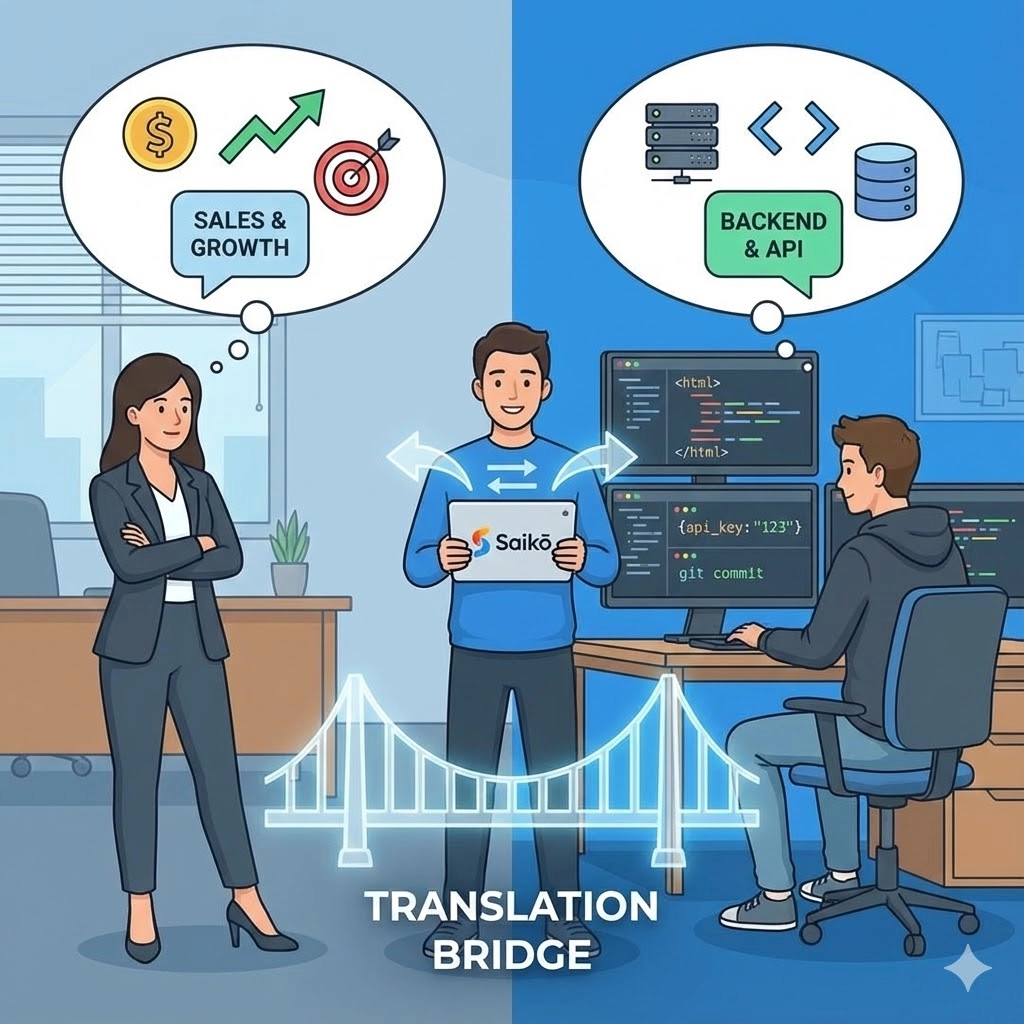
Let’s admit a truth rarely spoken out loud in meeting rooms. For a non-technical person (a business owner, a marketing director, a project manager), talking to a developer can be intimidating.
You talk about “business goals,” “increasing sales,” and “customer experience.” They respond with “APIs,” “backend frameworks,” and “database migrations.” It feels like trying to order dinner in a language where you only know three words.
The result? Misunderstandings, delays, and the eternal complaint: “But I asked for X, and they built Y.”
The truth is, you don’t need to learn how to code to communicate effectively. You just need to change how you describe what you want. Here is Saikō’s “Survival Guide” for a harmonious, high-yielding collaboration:
1. Describe the “What” and “Why,” Not the “How”
The biggest mistake non-tech people make is trying to prescribe technical solutions.
- Wrong approach: “I want you to put a dropdown menu here that uses AJAX to pull data…”
- Right approach: “I want the user to easily select their city without waiting for the page to reload, because we see customers dropping off at that point.”
Whether you are commissioning robust custom web applications and platforms or a simple internal workflow tool, the developer is the engineer. You are the architect of the experience. Tell them the problem and let them find the best technical solution.
2. Don’t Be Afraid to Say “I Don’t Understand”
When a developer starts speaking in acronyms (SDK, JSON, Git), don’t just nod along, fearing you’ll look silly if you ask. Stop them. Say: “Sorry, this ‘API’ you mentioned, what exactly does that mean for the end-user?”
It is their job to explain the business implications of the technology in plain English. If they can’t, there is a communication problem. Understanding how complex systems talk to each other through modern intelligent automation and API integration can save your company hours of confusion and misallocated funds down the line.
3. A Picture = 1,000 Lines of Code
Don’t describe features with essay-long emails. Developers think visually and structurally. Draw a quick sketch on paper. Use a simple wireframing tool to show the basic user flow. Show them an example from another site or service you like.
Whether you are planning customer-facing web services or highly responsive mobile and desktop apps, the more specific your visual example is, the fewer the misunderstandings will be.
4. Respect the “Just One Small Change”
This is where most professional relationships break down. To you, moving a button from right to left might seem like a 5-minute job. To the developer, it might mean rewriting the layout logic, altering the database structure, and running an entirely new battery of automated tests.
Before asking for a “small change” after implementation has begun—especially if your architecture handles predictive data tied to advanced AI and machine learning solutions—always ask: “What impact will this change have on our overall timeline and budget?”
The Saikō Role
At Saikō, we understand it’s not your job to become technical. Our job is to act as the ultimate “bridge.”
In every single project involving tailor-made software development, we serve as the dedicated translators who take your unique business vision and turn it into precise technical specifications, ensuring that what you ask for is ultimately what gets delivered—flawlessly.