“So, You’re Thinking About an E-shop.” What Does That Really Mean for Your Store?
From store shelves to the computer screen: moving to an e-shop has its challenges, like stock sync and logistics. Here’s a simple guide on how to successfully open your second, digital store.
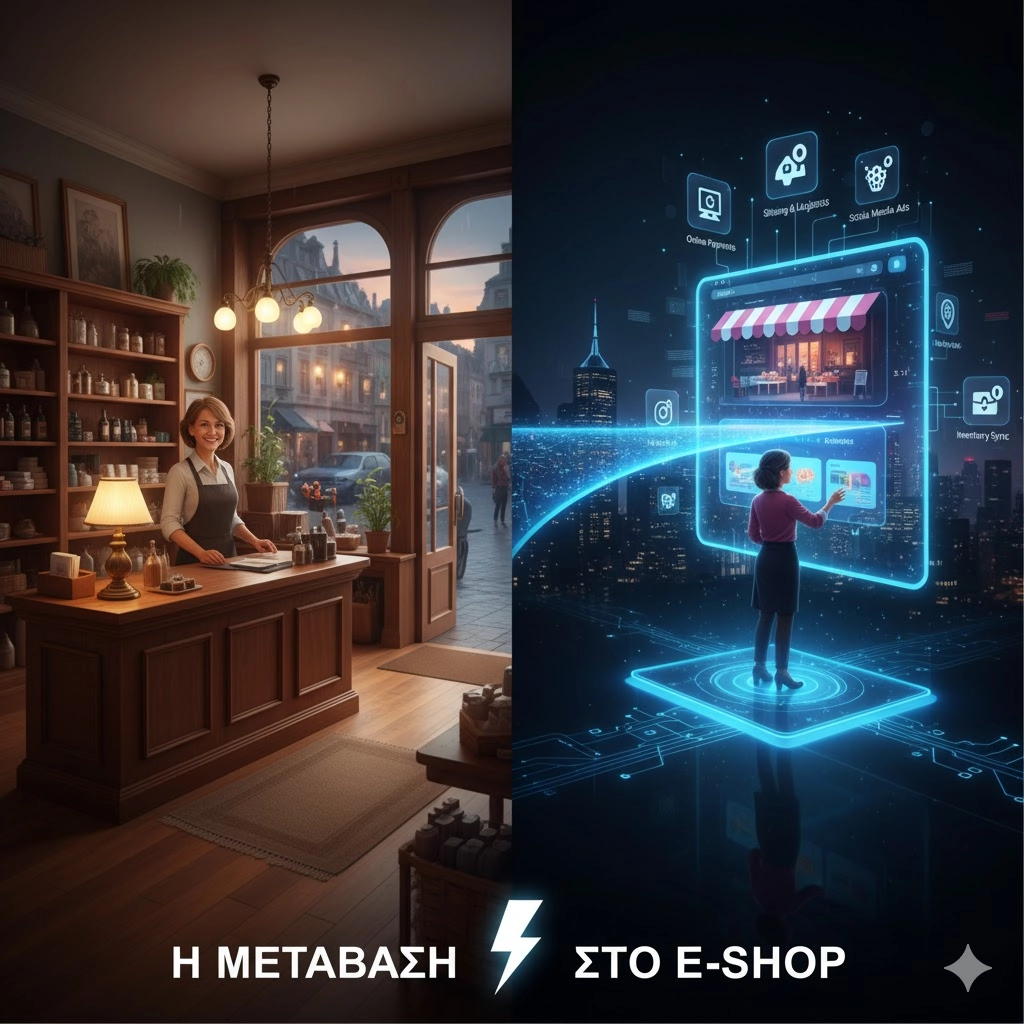
You have a successful physical shop. You’ve been running it for years. You know your product, your customers, your suppliers. You know when people come in, what they’re looking for, how to advise them. It’s your space, and you’re an expert in it.
And yet, lately, something’s been… bugging you.
Maybe it’s the customers who walk in and ask, “Do you have an e-shop?” Maybe you see your competition moving online. Maybe you just feel like you want to grow, to sell beyond the borders of your neighborhood or city.
The idea “I’ll build an e-shop” is the first step. But what do you actually need to do? How complicated is it?
The truth is, building an e-shop isn’t like building a simple website. It’s like opening a second store—a digital expansion that requires a strategic approach to tailor-made software development.
Let’s break down what that really means, step-by-step. No technical jargon, just plain English.
Step 1: The Big Question – What Will I Sell, and How Will I Find It?
In your physical store, inventory is simple: it’s what you see on the shelves and in the stockroom. In an e-shop, this is where the first challenge begins. You have to decide:
- Will you put all your products online?
- Will you start just with your best-sellers?
And here comes the most critical point that most people ignore: inventory synchronization.
Imagine this: You have 1 item left of a product. A customer walks into your physical shop and buys it. At the exact same moment, a customer sees it “Available” on your e-shop and orders it. You just created a very unhappy customer.
Before we even talk about platforms, you have to answer: “How will my shop’s shelf and my e-shop’s shelf ‘talk’ to each other?” Will it be manual? (Bad idea.) Will it be connected automatically to your ERP or your cash register? (A much, much better idea.) This seamless background communication is exactly what professional intelligent automation and API integration solves.
Step 2: The “Foundation” – Where Will the E-shop be “Built”?
Don’t stress about words like “Shopify,” “WooCommerce,” “Magento,” or “Custom.” Let’s put it simply:
- “Renting” (e.g., Shopify): This is like renting a ready-made, furnished shop in a big mall. It’s fast, easy to start, and you pay for everything by the month (rent, commissions), but you have strict limits on how you can decorate it and what you can do.
- “Owning” (e.g., WooCommerce/WordPress): This is like building your own store on your own plot of land. You have total freedom to do whatever you want and it is entirely yours, but you need an expert developer to build it right and you are responsible for its maintenance.
- “Bespoke” (Custom): This is for unique or highly complex business models. If you are selling something specialized (e.g., furniture with 100 different fabric options) or have advanced operational needs (e.g., connecting to 5 different international suppliers simultaneously), then building high-performing custom web applications and platforms from scratch is the ideal path forward.
The choice depends on how hands-on you’re willing to get and how unique your business workflows truly are.
Step 3: Your New “Shop Window” – Photos & Text
In the physical store, the customer picks up the product. They examine it, feel the material, and ask you questions directly. Online, the customer “picks up” the product entirely with their eyes.
If your photos are bad (dark, blurry, or showing only a single angle), it’s the digital equivalent of having a dirty, messy shop window. Good, clean photos aren’t a luxury; they are the absolute minimum requirement.
And the descriptions? These are your new “digital salespersons.” Instead of you telling the customer, “this fabric is excellent because…” your text has to do the talking. Boring, copied-and-pasted descriptions from a generic supplier sheet simply do not sell.
Step 4: The Nuts and Bolts – Payments & Shipping
You’ve opened your second store. Great. How will you get paid, and how will you send out the physical packages?
- Payments: You need a reliable connection with a payment gateway (e.g., Stripe, Viva Wallet, etc.) to securely accept credit cards. This comes with a small transaction commission, just like the physical POS machine in your retail shop.
- Shipping (Logistics): This is a completely new operational task. You have to strike a deal with one or more courier companies, print shipping vouchers, buy boxes, tape, and packing bags, and assign a team member to fulfill the orders.
Many modern retailers optimize this fulfillment phase by equipping their warehouse staff with dedicated mobile and desktop apps to manage real-time packing lists and scan items right from the warehouse floor.
Step 5: “I Built It. Will They Come?”
When you open a shop on a busy main street, you naturally get foot traffic from passersby. When you open an e-shop, it’s like opening a shop on an isolated, quiet side street. Nobody knows you exist unless you actively tell them.
You’ll need digital “signs” to guide them to your door. These signs include Social Media marketing (Facebook, Instagram), Google ads, and automated newsletters.
Furthermore, forward-thinking digital storefronts increasingly deploy advanced AI and machine learning solutions to dynamically analyze browsing patterns, display highly personalized product recommendations, and optimize marketing spend to maximize sales.
Is It a Mountain? No. It’s a Plan.
Does it sound like a lot to handle? Maybe. But it’s really no different from the steps you originally took to set up your physical shop. You found a commercial space, built the layout, secured a business license, and hosted a grand opening.
An e-shop is simply the next natural evolution of your business journey.
It doesn’t all have to be completely flawless from day one. You can comfortably start with a few select products and scale your infrastructure over time. The key is to view it not as an intimidating tech project, but as what it truly is: the exciting opening of your brand-new storefront.
If this looks like a map you don’t know how to navigate alone, that’s exactly what we are here for. At Saikō, we don’t just hand you a website; we plan and engineer the entire digital journey with you.